Showing posts with label Iran. Show all posts

Tuesday, August 28, 2012

Iran Call for Nuclear Abolition by 2025 is Unreported by New York Times

Logo of the Non-Aligned Movement
(photo: Wikipedia)
This guest blog was written by Alice Slater.

The Non-Aligned Movement (NAM), formed in 1961 during the Cold War, is a group of 120 states and 17 observer states not formally aligned with or against any major power bloc.  The NAM held its opening 2012 session yesterday under the new chairmanship of Iran, which succeeded Egypt as the Chair.

Significantly, an Associated Press story in the Washington Post headlined, “Iran opens nonaligned summit with calls for nuclear arms ban”, reported that “Iranian Foreign Minister Ali Akbar Salehi opened the gathering by noting commitment to a previous goal from the nonaligned group, known as NAM, to remove the world’s nuclear arsenals within 13 years. ‘We believe that the timetable for ultimate removal of nuclear weapons by 2025, which was proposed by NAM, will only be realized if we follow it up decisively,’ he told delegates.”

Monday, July 2, 2012

The Iranian Conundrum In Nuclear Disarmament


In his usual blunt diplomacy, Russian President, Vladimir Putin warned Israel not to jump into immediate action against Iran, citing precedence to Iraq and Afghanistan; as he said, “to do something without knowing the final consequence is not that smart.”  This came during his visit to Israel last week, and after repeated threatening remarks by Israeli leadership to take military action if Iran does not halt its nuclear enrichment.
Would an attack on Iran delay a nuclear program?
Downsides of threatening Iran: Iran is rooted in nationalism, therefore, to threaten it would potentially take away from its own citizenry defying nuclear enrichment, and instead the country would come together to thwart off an outside attack.  Right now, it is imperative for Iranian citizens to initiate a collective stance against the enrichment program.  If the people of Iran gain an influential voice against this and if internal legitimacy is compromised in this aspect, Iran will be left with little options but to cooperate with both its people and the international community on its nuclear facilities.  Ofcourse, this isn’t a roadmap to what will happen, but it can remain a hopeful option. 

Friday, June 29, 2012

Nuclear Iran Does Not Increase Stability: 8 Reasons

In the July issue of Foreign Affairs, international relations scholar and founder of neorealism, Kenneth Waltz, published a column not only defending nuclear deterrence theory, but also supporting the Iran obtaining a nuclear weapon (part of the column can be found on the website of USA Today). Waltz identifies three possible futures that could be had depending on the actions of Iran’s nuclear enrichment program. I find his analysis selective and the publishing of such opinions as legitimate in both the academic and mainstream press, without acknowledging the disastrous consequences that are possible in the case that his presumptions are false, to be reprehensible. I thus write this response.

One of the biggest issues with Waltz’s analysis is his complete dismissal of the incomprehensible dangers of nuclear weapons. He writes, “A palpable sense of crisis still looms,” and then dismisses it by saying, “It should not.”1 In the words of Nuclear Age Peace Foundation president David Krieger, “fear is a healthy mechanism when one is confronted by something fearful.”2 The Hiroshima and Nagasaki bombs killed 200,000 initially and many more in the months and years after. The current warheads are much larger than those two, plus new reports discuss how the nuclear famine that would follow a limited nuclear exchange between Pakistan and India could kill over 1 billion human beings.3 Luckily for us, Mr. Waltz is not worried. He thinks, “A nuclear-armed Iran would probably be the best possible result of the standoff and the one most likely to restore stability to the Middle East.” I beg to differ.

Thursday, June 21, 2012

Economic Partnerships as a Tool for Peace Between Iran and the U.S.


Economic sanctions in Iran and around the world have not only been ineffective, but have lead to increased hostility, militarism, and distrust. What if there was another economic means to pacifying the interactions between the United States and Iran? What if this solution has already proven to be successful in the modern era?

The development of economic partnerships, rather than sanctions, is an alternative to the predominant strategies of the current global order; a strategy that would, “Make it plain that any war…becomes not merely unthinkable, but materially impossible,”1 as stated by former French Prime Minister and first ever President of the European Assembly (the parliamentary institution of the European Union) Robert Schuman. Identifying the disastrous consequences of repeated conflict in Europe, Schuman paved the way for the creation of the European Union through his declaration and development of the European Coal and Steel Community (ECSC). To this day there has not been an armed conflict between members of the European Union and ECSC partnership, a partnership formed only five years after World War II ravaged across Europe.*


Wednesday, June 20, 2012

A Case Against Iranian Economic Sanctions

"Please do not touch, very expensive," the signs reads.

As an Iranian-American, I’ve visited Iran numerous times in my life-time. Some of my fondest memories take place in the hubs of the country: the bazaars. It’s in these busy and lively marketplaces where gossip and news are exchanged and where one could buy everything from fruits and meat to gold and not-so-authentic Rolex watches. During my last visit, in December of 2011, the bazaars were bustling with crowds and activities as much as ever. However, what differed from my previous visits were the numbers on the price signs that at first glance I thought had 3 or so extra digits by mistake and the sense of panic and frustration that resonated with shoppers and shop keepers alike. This is just a small glimpse as to how the Iranian economic sanctions have negatively affected the average people of Iran.

Monday, June 4, 2012

Stuxnet...An Act of War Against Iran?


In 1935 102 cane toads were introduced in Eastern Australia as a tool to control the cane beetle, a local pest to sugar cane. Today there are over 200 million cane toads in Australia, which besides poisoning pets and humans as well as depleting native fauna has directly cost local governments hundreds of thousands of dollars to control, on top of the other economic losses caused by the introduced species. 1

This is not a story about toads though. This is a story about a virus the United States introduced to the internet which could have much greater consequences than some toads down under. This is a story about the United States authorizing acts of war against Iran over the enrichment of nuclear fuel.

Thursday, September 8, 2011

What Hypocrisy?

Breaking news from the United Nations Security Council: The United States, the UK, France and Germany have formally charged Iran with violating Security Council Resolution 1929, which bars Iran from undertaking ballistic missile activity. Apparently the activity in question is Iran's recent launch of its Rasad 1 satellite, which relies on ballistic missile technology.

Fair enough, right? I don't think Iran should be developing, testing or deploying ballistic missiles that are capable of carrying nuclear warheads.

But wait! The US Air Force has scheduled its next test of its Minuteman III Intercontinental Ballistic Missile for September 21 - the International Day of Peace. The US has test-fired the Minuteman III over 200 times since its introduction into the US nuclear arsenal in the 1970s. As David Krieger wrote in a recent opinion piece, "The US approach to nuclear-capable missile testing seems to be 'do as I say, not as I do.'  This is unlikely to hold up in the long run."

If the US, UK, France and Germany would spend as much time and energy pursuing the global conditions necessary for the abolition of all nuclear weapons as they do pursuing hypocritical UN Security Council resolutions, we would all be better off.

By the way, you can take action to oppose the September 21 launch of the US nuclear missile at this link.

Thursday, December 23, 2010

New Year, Old Conflicts


Nuclear crises in 2011 and their implications for US-China relations
As the New Year is upon us, it might be worth looking at what 2011 will bring in terms of potential international crises, especially those with a nuclear dimension to them. Two conflicts in particular seem as if they might escalate into military action: first, the sharply rising tensions between North and South Korea, and, second, the standoff between Iran and the US and its allies on Tehran’s nuclear ambitions. A third conflict worth mentioning is the ongoing dispute between India and Pakistan which, ever since both countries achieved nuclear weapons capability, has taken an especially ominous turn.
No real surprises there. These three are among the usual suspects when it comes to threats to international peace and security. Nevertheless, these cases deserve to be mentioned as they involve nuclear security concerns and, interestingly, also shed some light on the increasingly strained relationship between the United States and China.

Monday, November 8, 2010

That Little Problem of Nuclear Energy

 I recently wrote this short piece for an online publication in the UK called The Fresh Outlook.

Iran’s Bushehr nuclear power plant makes the world a more dangerous place. There – I said it. On this point, I am in agreement with the hardliners in Israel, the United States and the West in general. Where our viewpoints diverge, though, is why it is dangerous and what we should do about it.

Article IV of the nuclear Non-Proliferation Treaty gives “the inalienable right of all the Parties to the Treaty to develop research, production and use of nuclear energy for peaceful purposes.” In this sense, Iran is well within its rights to develop and operate one or more nuclear power plants.

However, given the relative ease with which a country can employ dual-use technologies to clandestinely develop a nuclear weapons programme, perhaps it is time to reconsider spreading nuclear power plants across the globe. Apart from the astronomical expense, danger of operation and lack of a plan for highly toxic waste, a double standard of encouraging nuclear energy in “good” countries and trying to prevent it in “bad” countries simply cannot hold.

Thursday, October 21, 2010

Need Some Cash? Saudia Arabia Now Buying Weapons

The United States just announced its biggest arms deal EVER: a $60 billion sale to Saudi Arabia. The biggest US arms sale ever - that's saying a lot. We export weapons to countries all over the globe; it's nothing new. Fighter jets here, helicopters there. What really blows me away about this deal is the US government's inability to understand that history tends to repeat itself.

The US Assistant Secretary for Political-Military Affairs, Andrew Shapiro, said that this deal with Saudi Arabia is intended in large part to counter the threat that Iran poses to the Saudis. 

OK. It's 2010. Saudi Arabia is a US ally. Iran is an enemy. But let's go back for a moment to the 1950s, 60s and 70s. Iran, under the autocratic rule of Shah Mohammad Reza Pahlavi, was a major US ally. We encouraged Iran to develop a nuclear (energy) program and turned a blind eye to the repressive tactics of the Shah.

Monday, October 11, 2010

Iran Is Unphased by the Saber Rattling

Regarding nuclear weapons, the US message to Iran has been “do as we say, not as we do.” We tell Iran that they cannot have nuclear weapons, but we do so in the context of relying upon these weapons for our own security and being silent about Israel’s nuclear arsenal. This is clearly an irksome double standard for Iran, one that would be far easier to tolerate if the US showed it was serious about eliminating its own nuclear arsenal and pressuring the other nuclear weapons states, including Israel, to do the same.

Further, Iran was one of three countries, along with Iraq and North Korea, named by George W. Bush as belonging to an Axis of Evil. We invaded Iraq, which had no nuclear weapons, and negotiated with North Korea, which does have them. Our behavior, on its face, would seem to be an incentive to countries not on friendly terms with the US to develop nuclear arms and justify their actions in the name of national security.

US saber rattling must give pause to Iran and, for that reason, Iran will likely stop short of actually creating nuclear weapons. On the other hand, it seems that Iran is motivated to continue to push the envelope. Its leaders most likely believe that the strategic costs to the US of attacking Iran would be too great for the US to actually initiate an attack, particularly since it is still engaged in wars in Iraq and Afghanistan.

The bigger danger to Iran is an Israeli attack on its nuclear facilities, but it is doubtful that Israel would act without approval by the US. A preventive Israeli attack on Iran would be far more complicated and far less likely to succeed than its 1981 attack on Iraq’s Osirak reactor. An attack by Israel could result in a more general war in the Middle East, which would be disastrous for the region and would almost certainly lead to restricting Middle East oil exports with consequent global economic chaos.

Monday, August 16, 2010

Update on Iran


It seems that U.S. voters are not the only party feeling disillusioned about Obama’s campaign promises of “Hope” and “Change.” The 2010 Arab Opinion Poll, taken by the University of Maryland and Zogby International, shows a downswing in Obama’s approval ratings and a sharp decline in overall optimism about the administration’s Middle East foreign policy. This shift in opinion is accompanied by a notable increase in support for a nuclear Iran.

The poll’s sample size is just under 4,000 individuals and includes nationals of Egypt (818), Saudi Arabia (812), Morocco (816), the United Arab Emirates (512), Lebanon (509), and Jordan (509). The participants were polled on a number of broad topics, including identity; world view; the Arab-Israeli conflict; the United States and the Middle East; and Iran.

The percentage of respondents who believe that Iran is seeking nuclear weapons rather than peaceful research hasn’t changed much (a 55% majority, compared to last year’s 59%). However, while a reassuring 40% felt that Iran should be pressured to curtail its nuclear program in last year’s poll, only 20% of all 2010 respondents favored curtailment. Similarly, attitudes about the regional impact of a nuclear armed Iran seem to have been reversed: in 2009, a mere 29% said that they thought the outcome for the Middle East would be “more positive” if Iran acquired nuclear weapons, while 46% said “more negative.” This year, 57% choose the “more positive” option, and only 21% “more negative.”

Shibley Telhami, Professor of Peace and Development at the University of Maryland and a nonresident senior fellow at the Saban Center for Middle East Policy at Brookings, headed the poll. In an interview with Voice of America News, he stated that the 35% decrease in “hopeful” attitudes about U.S foreign policy was directly correlated to increased support for Iran. “When they’re optimistic about our American foreign policy,” said Telhami, “they’re much tougher on Iran.”

The truth is that it’s getting harder for anyone to be optimistic about U.S. foreign policy – particularly where Iran is concerned. On Sunday, the Los Angeles Times reported that the U.S. and EU’s most recent attempts to halt Iran’s nuclear program have been largely unsuccessful. After the U.N. adopted somewhat lax trade sanctions against Iran in June, the U.S. and EU hurried to add more stringent restrictions. The U.S. sanctions are aimed at preventing the sale of refined petroleum products and aid in refinement of petroleum to Iran, while the EU sanctions penalize foreign investment in banking, shipping, insurance, transportation as well as energy and nuclear-related industries.

The economic pressure exerted by the sanctions is intended to curb Iran’s nuclear development. Despite the U.S. Department of State’s assurances that they are, in fact, having an effect on the "thinking in Tehran” there seems to be a hiccup in the plan. China, Russia, India and Turkey have moved ahead on investments that violate the sanctions, taking advantage of the opportunity to expand their business. Indian daily The Hindu reports that Iran has also decided to dramatically reduce gasoline consumption and work towards self-sufficiency in its domestic refining sector. These steps, combined with foreign support from China, Russia, India and Turkey could very well take the sting out of the U.S. and EU sanctions.

Unsurprisingly, neoconservatives are endorsing a military “solution” to Iran. U.S. House of Representatives’ Resolution 1553 explicitly provides support for Israeli military strikes against Iran, backing Israel's use of “all means necessary” “including military force.” The resolution has garnered the support of nearly on third of House Republicans, yet supporters seem to be ignoring expert opinion Secretary of Defense Robert Gates, General David Petraeus, The Brookings Institution's Saban Center, and the Oxford Research Group all agree that another war in the Middle East would be disastrous, and do nothing to curb Iran’s nuclear aspirations.

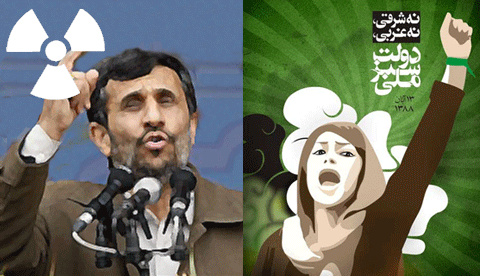
Celebrated Iranian journalist Akbar Ganji adds to the chorus of protestors, noting that an attack on Iran would decimate Iran’s growing Green Movement. “The mere fact that Obama didn't make military threats made the Green Movement possible," Ganji stated. He refers to Iran's increasingly secular liberal democratic movement, which is comprised largely of the middle class and college educated youth from all social classes. The Green Movement was born in response to Mahmoud Ahmadinejad’s victory in the June 2009 elections. Protestors flocked to the streets to decry what they regarded as a fraudulent election. Although Ahmadinejad retained power, Green Movement continues to push for democracy and civil rights within the framework of the existing regime. Ganji is optimistic about the movement’s future, but says that it needs time to stabilize and develop leadership. “It's not to our benefit for this regime to collapse today,” Ganji explained, “You need an experienced democratic force that will be able to replace the regime.”

So where do we go from here? According to Secretary of State Hilary Clinton, engagement is still an option. Iran has to “reassure the international community by words and actions as to what their nuclear program is intended for," Clinton told The New York Times. We can only hope that U.S. - Iran relations don’t take a turn for the worse; military action would be madness in light of plummeting Arab opinion, lack of support from other nations, and the warnings of intellectuals and military leaders alike.

Preventing Iran from developing of a nuclear arsenal is certainly important in the struggle for non-proliferation, but perhaps it is even more important to look closer to home. Reflecting once again on Obama’s campaign promises of “hope” and “change,” it seems high time for the administration to make good on their promise to work toward U.S. disarmament. A little more than two years ago, Obama told CNN, "It's time to send a clear message to the world: America seeks a world with no nuclear weapons." The then-candidate continued, “we'll make the goal of eliminating all nuclear weapons a central element in our nuclear policy." With ratification of the START treaty stalled until after summer recess and no clear roadmap for fulfilling the Treaty on the Non-Proliferation of Nuclear Weapons, however, the “clear message” sent by U.S. nuclear policy sounds a bit like double talk. A nuclearized Iran is certainly a terrifying prospect, but it is the U.S.’s massive arsenal that has helped create a world in which nuclear weapons are ubiquitous with political clout. We can hardly inspire other nations to rethink the role of these weapons in their foreign policy without taking measures to show that we are doing the same. Ultimately, while staying true to the goal of non-proliferation, the U.S. must tread carefully, speak softly, and be very careful about wielding any big sticks.

Wednesday, June 9, 2010

Irate Iran: How The Latest Round of Sanctions Will Not Curb The Iranian Nuclear Program

Earlier today, the United Nations passed a fourth round of sanctions against Iran in a vote 12-2, with only Brazil and Turkey dissenting (and Lebanon abstaining).  The sanctions are an attempt to curb Tehran’s nuclear program, which many in the international community believe Iran will use to manufacture a useable nuclear weapon. Iran has repeatedly disregarded UN demands to cease nuclear enrichment, even moving plants to secret locations to evade officials.  In defiance of the UN, Iran announced earlier this year that it would enrich uranium to 20%, as well as construct new nuclear facilities. Tehran has also shown continual intransigence regarding IAEA inspections and protocol. 

This latest round of sanctions includes increased measures against select individuals of the Iranian Revolutionary Guard, increased security measures of vehicles coming from/going to Iran, and banning all nations from investing in Iranian nuclear technology.  Given that the three previous rounds of sanctions failed to have any lasting effect on Iranian nuclear efforts, it is highly unlikely that the latest round will make a dent, either.   
Related Posts Plugin for WordPress, Blogger...