Friday, August 6, 2010

The Real Price of Nuclear Weapons

By Adrianna Wolaver

If you ask an economist for a price, their answer will not only include the number where the supply and demand curves intersect, but the opportunity cost for those resources. The concept is simple; what else could have been done with that time and/or money? That’s the opportunity cost. Recently, Stephen Shwartz, author of Atomic Audit, has put the price tag of the entire pursuit of nuclear deterrence since 1940, including development, maintenance, and expansion, at $7.5 trillion.[1] Today we spend $55 billion annually on nuclear weapons and related programs.[2] To some people this may seem like a reasonable price for “nuclear security” and global military dominance, but I want to challenge you to think about what else that money could do.

There are eight Millennium Development Goals (MDGs) set forth in 1990 by the United Nations designed to substantially improve the quality of life and safety of our planet. The eight goals are as follows:
  1. eradicating extreme poverty and hunger by halving the proportion of people living on less than $1 a day, 
  2. achieving universal primary education, 
  3. promoting gender equality and empowering women, 
  4. reducing child mortality by two-thirds, 
  5. improving maternal health by reducing maternal mortality ratios by two-thirds, 
  6. combating HIV and AIDS, malaria and other diseases, 
  7. ensuring environmental sustainability, and 
  8. creating a global partnership for development.[3] 
The MDGs' 2015 deadline is fast approaching and many of the goals are far from being reached. It is possible, however, to reach these goals with $40-60 billion per year in foreign aid. [4] In order to put our nuclear weapons budget into perspective, I am comparing the United States’ annual nuclear budget of $55 billion with the foreign aid that is needed annually in order to reach the MGDs. Let’s close our eyes and imagine that we could redirect $55 billion a year to the MDGs.

Wednesday, August 4, 2010

Upcoming Reminder for Sadako Peace Day


The Nuclear Age Peace Foundation will remember the 65th anniversary of the Hiroshima bombing on August 6th with our annual Sadako Peace Day Memorial. The event will take place in the Sadako Peace Garden at the Casa de Maria Retreat Center.

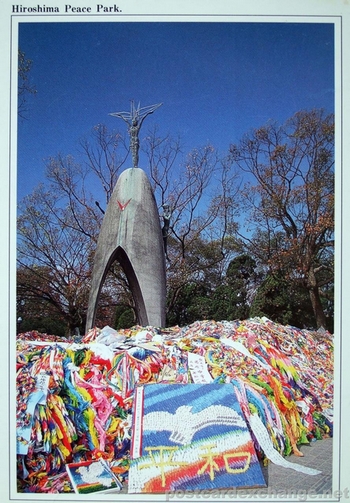
Sadako Sasaki was just two years old when the atomic bomb fell on Hiroshima. She survived the bombing, but was later diagnosed with leukemia. As her condition progressed, she began folding origami cranes, inspired by the Japanese saying that one who folds a thousand papers cranes was granted a wish. She finished her thousand paper cranes and continued folding more. Tragically, leukemia took Sadako’s life at the age of twelve. Japanese children fold cranes in her memory, and leave thousands at her memorial in the Hiroshima Peace Park every year on August 6th.

Sadako’s story can inspire all of us to believe in peace. If you are in the Santa Barbara area, we invite you to join us at Sadako Peace Day. If not, we encourage you to reflect on the subject of peace and how we can share peace in the future. For a fun activity, make you own paper crane and place it in a spot where it will remind you of peace. For instructions click here.

Message for Hiroshima Day

The Nuclear Age has entered its 65th year. The first test of a nuclear device took place on July 16, 1945 at the Alamogordo Test Range in New Mexico’s Jornada del Muerto Desert. The Spanish name of this desert means “Journey of Death,” a fitting name for the beginning point of the Nuclear Age. Just three weeks after the test, the United States destroyed the city of Hiroshima with a nuclear weapon, followed by the destruction of Nagasaki three days later. By the end of 1945, the Journey of Death had claimed more than 200,000 human lives and left many other victims injured and suffering.

Over the past 65 years, the Journey of Death has continued to claim victims. Not from the use of nuclear weapons in war, but from the radiation released in testing nuclear weapons (posturing). We can be thankful that we have not had a nuclear war in the past 65 years, but we must not be complacent. Our relative good fortune in the past is not a guarantee that nuclear weapons will not be used in the future. Over the years, the power of nuclear weapons has increased dramatically. They have become capable of ending civilization and complex life on the planet. What could possibly justify this risk?

Monday, August 2, 2010

Countdown to Zero Follow-Up

Countdown to Zero was a great success here in the LA area.  To those of you who came out to see it, thank you!  If you haven't seen it yet, CtZ is still playing in theaters.  Everybody at NAPF loved it, and those who we talked to after the movie liked it as well; we were quite pleased how responsive people were after the film.  It is a well-made and beautifully photographed film--so go see it now!

Also, check out Valerie Plame's recent article in Newsweek, written as a corollary to the film.  She discusses the dangers of nuclear terrorism and the hope for a world without nuclear weapons.  
Related Posts Plugin for WordPress, Blogger...