Showing posts with label Hiroshima. Show all posts

Tuesday, August 7, 2012

Call for Peace from Hiroshima and Nagasaki


Nagasaki Peace Bell

At 8:15 am, on August 6, the Peace Bell at the Hiroshima Peace Park begins ringing, and people closing their eyes start praying for the victims of atomic bombings as well as for world peace without nuclear weapons. Another bell rings in Nagasaki at 11:02 am on August 9.


Last summer, I visited Nagasaki and attended the peace ceremony for the first time. Despite hot and humid weather of summer in Nagasaki, many people came to the Peace Memorial Park, including hibakusha (A-bomb survivors), politicians, students, children, and people from other countries. I was outside of the main place when I heard the peace bell ringing. With complete silence in the park, the deep sounds of the bell were only resonating as if it was carrying all the memories of the A-bomb victims and our prayers for world peace.  


Monday, August 6, 2012

The Unnecessary Bombing of Hiroshima: 67 Years Later

Today marks the 67th anniversary of the bombing of Hiroshima. August 6th, 1945 is day in which violence, hate, and patriarchic posturing led to the unnecessary death of hundreds of thousands of people. While the actions of the American government are often described as regrettable, unfortunate, and horrific, we also celebrate these bombings either through claiming their necessity or in the indoctrination of false history for our children within their schools.

Are bombs really an answer to our problems? This blog will describe two scenarios, one fictional and one historical, which prove nuclear weapons are not a solution to international conflict.

Nuclear Weapons Were Not Needed in Japan

Growing up in school I was always taught the Japanese war effort was still strong going into the summer of 1945; that a full land invasion of Tokyo would be required for the allies to cause Japan to submit. It is this logic that is used to justify the intolerable use of nuclear weapons on the civilians of Japan. This could not be further from the truth. Admiral William D. Leahy, the President's Chief of Staff, wrote in his memoir that, “The use of this barbarous weapon at Hiroshima and Nagasaki was of no material assistance in our war against Japan. The Japanese were already defeated and ready to surrender.”1


Wednesday, August 1, 2012

The Story of Sadako and the Thousand Paper Cranes


The Story of Sadako and the Thousand Paper Cranes


August is a bittersweet month. It is the month in which we mournfully remember the atomic bombings of Hiroshima and Nagasaki on August 6 and August 9 during the final stages of World War II. The nuclear weapons, developed and deployed by the United States, brought complete obliteration to the two cities and killed approximately 200,000 Japanese from both immediate and long-term effects. Most of the Japanese who fell victim to the nuclear weapons were innocent civilians. The laws of war and ethical standards were shattered, and the United States set a precedent of nuclear proliferation. Yet, although August is the month in which we reflect on the horrors of Hiroshima and Nagasaki, it is also the month in which worldwide peace efforts that stemmed from such tragedy are celebrated. The story of Sadako Sasaki is one story that has inspired generations to pursue a peaceful and just world.

Monday, August 1, 2011

The Power of Voice

As some of you know we are just around the corner from the Nuclear Age Peace Foundation’s 17th annual Sadako Peace Day. While this day holds special significance for us at the Foundation, it also serves as a reminder of our role as a human race to wage peace and use our voices as a source of power.

When we think back about the great peace leaders in history they all seem to recognize one thing: the power of voice. I mean think about it- What would the world be like if on August 28th 1963 Martin Luther King Jr. only thought, “I have a dream.” What about if in 1873 Susan B. Anthony decided that giving a speech on women’s right to vote would be better left unsaid? After all, she had just been arrested for casting an illegal vote in the presidential election.

German-Swiss poet and novelist, Herman Hesse, once said “Everything becomes a little different as soon as it is spoken out loud.” And he’s right; the power of voice is the best tool we have to stand up for what we believe in. It is able to transcend time, promote social change, and advocate a safer nuclear-weapons free world for generations to come.

So I have to admit, when I first learned about the power of voice I was skeptical. I thought, 'sure it must be easy to inspire and unite the masses once you have perfected the art of oratory like John F. Kennedy or Malcom X, but most of us have not mastered the skills of communication.' That is where Sadako Sasaki comes in.

Sadako Sasaki was only two-years old when the atomic bomb was dropped on Hiroshima. Ten years later she was diagnosed with leukemia and made it her dying wish to spread peace on the wings of 1000 paper cranes. This courageous little girl said, “I will write peace on your wings, and you will fly all over the world.” Sadako was not a professional speaker or wizard of words, but she was able to able to leave her legacy through her heartfelt message and compassion for humanity. And like the great peace leaders throughout history, she recognized the power of her own voice.

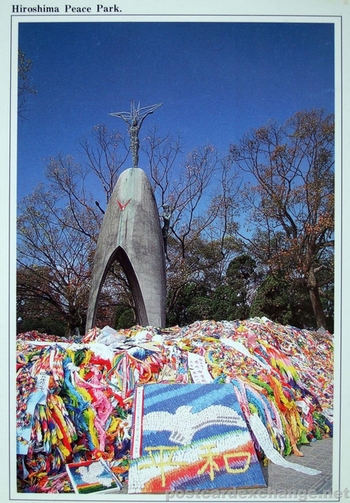
Since Sadako’s death, children and adults from countries all over the world honor her spirit by creating paper cranes as symbols of peace. Many of them even travel to the Children’s Peace Monument in Hiroshima where they bring their own folded paper cranes as a message of peace and desire for the abolition of nuclear weapons. In memory of Sadako let us be reminded that we can protect our world through the power of our own voice, no matter how average that voice may be.


Wednesday, March 23, 2011

The Road to Freedom, The Road to Peace


Upon reaching Birmingham, Alabama, we were greeted by warm sunshine and a haunting stillness in the heart of the vibrant city. With a group of five other students, we entered our history of discrimination and segregation at Kelly Ingram Park. While our trip was focused specifically on racial issues and reconciliation the parallels to peace in the nuclear age were very real.

It’s hard to imagine that at one point in time, this beautiful place was all but beautiful. Smoke filled the sky, people ran amuck, as police dogs and billy-clubs met innocent marchers at Kelly Ingram Park. These people knew the risks of their participation in nonviolent protests. They knew they could die and lose it all. However, they also knew that morally they could wait no longer for justice. A placard with the words of Anne Frank reads, “How wonderful it is that nobody need wait a single moment before starting to improve the world.”

Wednesday, August 4, 2010

Upcoming Reminder for Sadako Peace Day


The Nuclear Age Peace Foundation will remember the 65th anniversary of the Hiroshima bombing on August 6th with our annual Sadako Peace Day Memorial. The event will take place in the Sadako Peace Garden at the Casa de Maria Retreat Center.

Sadako Sasaki was just two years old when the atomic bomb fell on Hiroshima. She survived the bombing, but was later diagnosed with leukemia. As her condition progressed, she began folding origami cranes, inspired by the Japanese saying that one who folds a thousand papers cranes was granted a wish. She finished her thousand paper cranes and continued folding more. Tragically, leukemia took Sadako’s life at the age of twelve. Japanese children fold cranes in her memory, and leave thousands at her memorial in the Hiroshima Peace Park every year on August 6th.

Sadako’s story can inspire all of us to believe in peace. If you are in the Santa Barbara area, we invite you to join us at Sadako Peace Day. If not, we encourage you to reflect on the subject of peace and how we can share peace in the future. For a fun activity, make you own paper crane and place it in a spot where it will remind you of peace. For instructions click here.

Message for Hiroshima Day

The Nuclear Age has entered its 65th year. The first test of a nuclear device took place on July 16, 1945 at the Alamogordo Test Range in New Mexico’s Jornada del Muerto Desert. The Spanish name of this desert means “Journey of Death,” a fitting name for the beginning point of the Nuclear Age. Just three weeks after the test, the United States destroyed the city of Hiroshima with a nuclear weapon, followed by the destruction of Nagasaki three days later. By the end of 1945, the Journey of Death had claimed more than 200,000 human lives and left many other victims injured and suffering.

Over the past 65 years, the Journey of Death has continued to claim victims. Not from the use of nuclear weapons in war, but from the radiation released in testing nuclear weapons (posturing). We can be thankful that we have not had a nuclear war in the past 65 years, but we must not be complacent. Our relative good fortune in the past is not a guarantee that nuclear weapons will not be used in the future. Over the years, the power of nuclear weapons has increased dramatically. They have become capable of ending civilization and complex life on the planet. What could possibly justify this risk?

Thursday, July 8, 2010

Animated Map of the 2,053 Nuclear Explosions Between 1945-1998

Japanese artist Isao Hashimoto created an animated map which shows the 2,053 nuclear tests which occurred between 1945 and 1998.  The final count (which does not include the two North Korean tests after 1998) is: US (1032), Russia (715), China (45), Great Britain (45), France (210), India (4), and Pakistan (2).  

Each test is represented by a metronomic blip, which, in the end, creates an eerie rhythm reminiscent of the exchange between humans and the alien spaceship in Close Encounters of the Third Kind.  The 14 minute long video begins slowly--illuminating the first test in New Mexico, followed by the devastating bombings of Hiroshima and Nagasaki in August, 1945.  The blips incrementally accelerate, and by the late 1950s the map lights up with numerous tests between the U.S. and Russia.


Tuesday, June 29, 2010

Sadako Peace Day Reminder


Nuclear Age Peace Foundation Director of Programs Rick Wayman will be the featured speaker at the 16th Annual Sadako Peace Day ceremony, Friday August 6, at the Sadako Peace Garden at La Casa de Maria, 800 El Bosque Road, between 6:00 and 7:00 p.m. Admission is free and open to the public.

His theme will be “Persistence and Dedication.” He will discuss the importance of working for a world free of nuclear weapons in spite of opposition – and why the support of many people is required for progress to be made towards nuclear weapons abolition. Wayman guides all programs at the Foundation – including worldwide efforts to educate and motivate people to work for nuclear disarmament.

The August 6th Sadako Peace Day ceremony will also feature poetry from several local poets, including Santa Barbara’s Poets Laureate Emeriti, Perie Longo and Barry Spacks and Glenna Luschei, Poet Laureate Emerita of San Luis Obispo. Bob Sedivy will provide beautiful, evocative music on the shakuhachi or traditional bamboo flute. And Janice Freeman-Bell will sing accompanied by Chris O’Connell on Native American flute.

Monday, June 7, 2010

Sadako Peace Day


Join us for music, reflection and poetry on August 6th, 2010 at 6pm at the Sadako Peace Garden, La Casa de Maria, 800 El Bosque Road, Montecito, CA.

The hour-long program will feature music from Janice Freeman-Bell and the haunting evocative sounds of the shakuhachi, or Japanese flute, played by Bob Sedivy.

The event is free and open to the public.

Wednesday, January 13, 2010

Today's Headlines: A Nuclear Aftermath?

All over the newspapers, internet and TV today we are seeing the unbelievable devastation caused by the earthquake near Port-au-Prince, Haiti. Thousands of collapsed buildings, infrastructure destroyed, an unknown (but very high) number of people dead or missing. My heart aches at the suffering this natural disaster has caused.

When I came in to work this morning, my thoughts turned to images of Hiroshima and Nagasaki in August 1945. Just as in Haiti today, buildings collapsed and a city was destroyed. In Japan, hundreds of thousands of innocent people were killed in a very short period of time, not by a natural disaster but a man-made one. The US atomic bombs, nicknamed "Little Boy" and "Fat Man," brought unforgettable destruction and anguish to those two Japanese cities.
Related Posts Plugin for WordPress, Blogger...