Showing posts with label Middle East. Show all posts

Tuesday, September 4, 2012

My Letter in the Wall Street Journal

The Wall Street Journal published a letter to the editor from me on Sunday, September 2. It appears as if the Journal is no longer archiving letters to the editor online, so the full text of the letter appears below.

The letters to the editor page is the second-most widely read page of a newspaper after the front page. It is a great way to get your message across to readers, especially in a publication known for coming down on the other side of your issue of interest.

I encourage everyone to write letters to the editor on issues they care about - both local papers and national ones. You can read my suggested guidelines for writing a letter to the editor here.

Here's the text of my letter, which refers to an op-ed that had been published by the Wall Street Journal earlier that week:

Mr. Kozak certainly places a lot of faith in the idea that "rational actors" with their finger on the nuclear trigger will act rationally at all times, even under extreme stress during times of war. This dangerous assumption overlooks the fact that one irrational decision with nuclear weapons could set off a chain of events that could kill hundreds of millions of people around the world through nuclear famine.
Furthering the gap between nuclear "haves" and "have-nots" through military action, as Mr. Kozak not so subtly infers, will only increase the incentive for other countries to develop nuclear weapons quickly. Negotiations for a Middle East Weapons of Mass Destruction-Free Zone, which would include both Iran and Israel, are supposed to take place in the coming months. This is a sensible way to halt real and possible nuclear proliferation in this volatile region of the world.
Rick Wayman
Nuclear Age Peace Foundation
Santa Barbara, Calif.

Thursday, October 21, 2010

Need Some Cash? Saudia Arabia Now Buying Weapons

The United States just announced its biggest arms deal EVER: a $60 billion sale to Saudi Arabia. The biggest US arms sale ever - that's saying a lot. We export weapons to countries all over the globe; it's nothing new. Fighter jets here, helicopters there. What really blows me away about this deal is the US government's inability to understand that history tends to repeat itself.

The US Assistant Secretary for Political-Military Affairs, Andrew Shapiro, said that this deal with Saudi Arabia is intended in large part to counter the threat that Iran poses to the Saudis. 

OK. It's 2010. Saudi Arabia is a US ally. Iran is an enemy. But let's go back for a moment to the 1950s, 60s and 70s. Iran, under the autocratic rule of Shah Mohammad Reza Pahlavi, was a major US ally. We encouraged Iran to develop a nuclear (energy) program and turned a blind eye to the repressive tactics of the Shah.

Monday, August 16, 2010

Update on Iran


It seems that U.S. voters are not the only party feeling disillusioned about Obama’s campaign promises of “Hope” and “Change.” The 2010 Arab Opinion Poll, taken by the University of Maryland and Zogby International, shows a downswing in Obama’s approval ratings and a sharp decline in overall optimism about the administration’s Middle East foreign policy. This shift in opinion is accompanied by a notable increase in support for a nuclear Iran.

The poll’s sample size is just under 4,000 individuals and includes nationals of Egypt (818), Saudi Arabia (812), Morocco (816), the United Arab Emirates (512), Lebanon (509), and Jordan (509). The participants were polled on a number of broad topics, including identity; world view; the Arab-Israeli conflict; the United States and the Middle East; and Iran.

The percentage of respondents who believe that Iran is seeking nuclear weapons rather than peaceful research hasn’t changed much (a 55% majority, compared to last year’s 59%). However, while a reassuring 40% felt that Iran should be pressured to curtail its nuclear program in last year’s poll, only 20% of all 2010 respondents favored curtailment. Similarly, attitudes about the regional impact of a nuclear armed Iran seem to have been reversed: in 2009, a mere 29% said that they thought the outcome for the Middle East would be “more positive” if Iran acquired nuclear weapons, while 46% said “more negative.” This year, 57% choose the “more positive” option, and only 21% “more negative.”

Shibley Telhami, Professor of Peace and Development at the University of Maryland and a nonresident senior fellow at the Saban Center for Middle East Policy at Brookings, headed the poll. In an interview with Voice of America News, he stated that the 35% decrease in “hopeful” attitudes about U.S foreign policy was directly correlated to increased support for Iran. “When they’re optimistic about our American foreign policy,” said Telhami, “they’re much tougher on Iran.”

The truth is that it’s getting harder for anyone to be optimistic about U.S. foreign policy – particularly where Iran is concerned. On Sunday, the Los Angeles Times reported that the U.S. and EU’s most recent attempts to halt Iran’s nuclear program have been largely unsuccessful. After the U.N. adopted somewhat lax trade sanctions against Iran in June, the U.S. and EU hurried to add more stringent restrictions. The U.S. sanctions are aimed at preventing the sale of refined petroleum products and aid in refinement of petroleum to Iran, while the EU sanctions penalize foreign investment in banking, shipping, insurance, transportation as well as energy and nuclear-related industries.

The economic pressure exerted by the sanctions is intended to curb Iran’s nuclear development. Despite the U.S. Department of State’s assurances that they are, in fact, having an effect on the "thinking in Tehran” there seems to be a hiccup in the plan. China, Russia, India and Turkey have moved ahead on investments that violate the sanctions, taking advantage of the opportunity to expand their business. Indian daily The Hindu reports that Iran has also decided to dramatically reduce gasoline consumption and work towards self-sufficiency in its domestic refining sector. These steps, combined with foreign support from China, Russia, India and Turkey could very well take the sting out of the U.S. and EU sanctions.

Unsurprisingly, neoconservatives are endorsing a military “solution” to Iran. U.S. House of Representatives’ Resolution 1553 explicitly provides support for Israeli military strikes against Iran, backing Israel's use of “all means necessary” “including military force.” The resolution has garnered the support of nearly on third of House Republicans, yet supporters seem to be ignoring expert opinion Secretary of Defense Robert Gates, General David Petraeus, The Brookings Institution's Saban Center, and the Oxford Research Group all agree that another war in the Middle East would be disastrous, and do nothing to curb Iran’s nuclear aspirations.

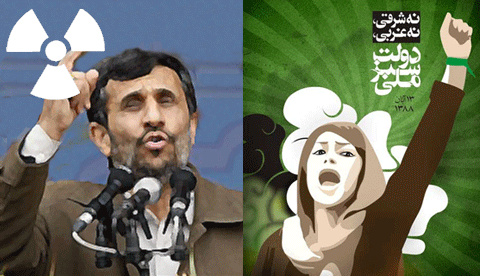
Celebrated Iranian journalist Akbar Ganji adds to the chorus of protestors, noting that an attack on Iran would decimate Iran’s growing Green Movement. “The mere fact that Obama didn't make military threats made the Green Movement possible," Ganji stated. He refers to Iran's increasingly secular liberal democratic movement, which is comprised largely of the middle class and college educated youth from all social classes. The Green Movement was born in response to Mahmoud Ahmadinejad’s victory in the June 2009 elections. Protestors flocked to the streets to decry what they regarded as a fraudulent election. Although Ahmadinejad retained power, Green Movement continues to push for democracy and civil rights within the framework of the existing regime. Ganji is optimistic about the movement’s future, but says that it needs time to stabilize and develop leadership. “It's not to our benefit for this regime to collapse today,” Ganji explained, “You need an experienced democratic force that will be able to replace the regime.”

So where do we go from here? According to Secretary of State Hilary Clinton, engagement is still an option. Iran has to “reassure the international community by words and actions as to what their nuclear program is intended for," Clinton told The New York Times. We can only hope that U.S. - Iran relations don’t take a turn for the worse; military action would be madness in light of plummeting Arab opinion, lack of support from other nations, and the warnings of intellectuals and military leaders alike.

Preventing Iran from developing of a nuclear arsenal is certainly important in the struggle for non-proliferation, but perhaps it is even more important to look closer to home. Reflecting once again on Obama’s campaign promises of “hope” and “change,” it seems high time for the administration to make good on their promise to work toward U.S. disarmament. A little more than two years ago, Obama told CNN, "It's time to send a clear message to the world: America seeks a world with no nuclear weapons." The then-candidate continued, “we'll make the goal of eliminating all nuclear weapons a central element in our nuclear policy." With ratification of the START treaty stalled until after summer recess and no clear roadmap for fulfilling the Treaty on the Non-Proliferation of Nuclear Weapons, however, the “clear message” sent by U.S. nuclear policy sounds a bit like double talk. A nuclearized Iran is certainly a terrifying prospect, but it is the U.S.’s massive arsenal that has helped create a world in which nuclear weapons are ubiquitous with political clout. We can hardly inspire other nations to rethink the role of these weapons in their foreign policy without taking measures to show that we are doing the same. Ultimately, while staying true to the goal of non-proliferation, the U.S. must tread carefully, speak softly, and be very careful about wielding any big sticks.
Related Posts Plugin for WordPress, Blogger...