Showing posts with label nuclear insanity. Show all posts

Thursday, September 23, 2010

Heads held high?

Interview with a true nuclear believer

Among the many obstacles to achieving lasting nuclear disarmament is the persistent belief that a nuclear arsenal provides a nation not just with security—a flawed notion itself—but with national prestige. The “superpower” status that allegedly comes with possession of nuclear weapons means that the rest of the world, particularly your enemies, will have to reckon with you. Thus, apart from their supposed deterring effects, a nuclear arsenal would put a nation in a position of parity with the “big boys”. At least, that’s how the argument goes. As a result, nuclear weapons are regarded by some as a source of pride. This sentiment is twisted and dangerous and continues to frustrate disarmament efforts.

A recent NEWSWEEK interview[1] with Dr. Abdul Qadeer Khan, widely considered the father of Pakistan’s nuclear bomb and often hailed as a hero by the Pakistani people, reveals how this narrative is ingrained in Pakistan’s nuclear ambitions and posture.

Leaving the strong anti-West rhetoric aside—including legitimate grievances about the Western nuclear power’s double standards regarding nuclear security matters—Dr. Khan’s answers provide some valuable insight into the psychology behind nuclear pride and prestige. Considerations of security, status and pride—all three closely interrelated—make up this sentiment. Excerpts.

Q: Most here take pride in the fact that Pakistan is a nuclear state and believe this has served as a deterrent to conventional war with India.

A: Yes, I fully agree. Our nuclear program has ensured our survival, our security, and our sovereignty ... I am proud to have contributed to it together with my patriotic and able colleagues.

Monday, August 16, 2010

Update on Iran


It seems that U.S. voters are not the only party feeling disillusioned about Obama’s campaign promises of “Hope” and “Change.” The 2010 Arab Opinion Poll, taken by the University of Maryland and Zogby International, shows a downswing in Obama’s approval ratings and a sharp decline in overall optimism about the administration’s Middle East foreign policy. This shift in opinion is accompanied by a notable increase in support for a nuclear Iran.

The poll’s sample size is just under 4,000 individuals and includes nationals of Egypt (818), Saudi Arabia (812), Morocco (816), the United Arab Emirates (512), Lebanon (509), and Jordan (509). The participants were polled on a number of broad topics, including identity; world view; the Arab-Israeli conflict; the United States and the Middle East; and Iran.

The percentage of respondents who believe that Iran is seeking nuclear weapons rather than peaceful research hasn’t changed much (a 55% majority, compared to last year’s 59%). However, while a reassuring 40% felt that Iran should be pressured to curtail its nuclear program in last year’s poll, only 20% of all 2010 respondents favored curtailment. Similarly, attitudes about the regional impact of a nuclear armed Iran seem to have been reversed: in 2009, a mere 29% said that they thought the outcome for the Middle East would be “more positive” if Iran acquired nuclear weapons, while 46% said “more negative.” This year, 57% choose the “more positive” option, and only 21% “more negative.”

Shibley Telhami, Professor of Peace and Development at the University of Maryland and a nonresident senior fellow at the Saban Center for Middle East Policy at Brookings, headed the poll. In an interview with Voice of America News, he stated that the 35% decrease in “hopeful” attitudes about U.S foreign policy was directly correlated to increased support for Iran. “When they’re optimistic about our American foreign policy,” said Telhami, “they’re much tougher on Iran.”

The truth is that it’s getting harder for anyone to be optimistic about U.S. foreign policy – particularly where Iran is concerned. On Sunday, the Los Angeles Times reported that the U.S. and EU’s most recent attempts to halt Iran’s nuclear program have been largely unsuccessful. After the U.N. adopted somewhat lax trade sanctions against Iran in June, the U.S. and EU hurried to add more stringent restrictions. The U.S. sanctions are aimed at preventing the sale of refined petroleum products and aid in refinement of petroleum to Iran, while the EU sanctions penalize foreign investment in banking, shipping, insurance, transportation as well as energy and nuclear-related industries.

The economic pressure exerted by the sanctions is intended to curb Iran’s nuclear development. Despite the U.S. Department of State’s assurances that they are, in fact, having an effect on the "thinking in Tehran” there seems to be a hiccup in the plan. China, Russia, India and Turkey have moved ahead on investments that violate the sanctions, taking advantage of the opportunity to expand their business. Indian daily The Hindu reports that Iran has also decided to dramatically reduce gasoline consumption and work towards self-sufficiency in its domestic refining sector. These steps, combined with foreign support from China, Russia, India and Turkey could very well take the sting out of the U.S. and EU sanctions.

Unsurprisingly, neoconservatives are endorsing a military “solution” to Iran. U.S. House of Representatives’ Resolution 1553 explicitly provides support for Israeli military strikes against Iran, backing Israel's use of “all means necessary” “including military force.” The resolution has garnered the support of nearly on third of House Republicans, yet supporters seem to be ignoring expert opinion Secretary of Defense Robert Gates, General David Petraeus, The Brookings Institution's Saban Center, and the Oxford Research Group all agree that another war in the Middle East would be disastrous, and do nothing to curb Iran’s nuclear aspirations.

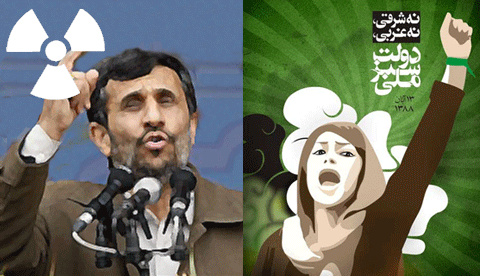
Celebrated Iranian journalist Akbar Ganji adds to the chorus of protestors, noting that an attack on Iran would decimate Iran’s growing Green Movement. “The mere fact that Obama didn't make military threats made the Green Movement possible," Ganji stated. He refers to Iran's increasingly secular liberal democratic movement, which is comprised largely of the middle class and college educated youth from all social classes. The Green Movement was born in response to Mahmoud Ahmadinejad’s victory in the June 2009 elections. Protestors flocked to the streets to decry what they regarded as a fraudulent election. Although Ahmadinejad retained power, Green Movement continues to push for democracy and civil rights within the framework of the existing regime. Ganji is optimistic about the movement’s future, but says that it needs time to stabilize and develop leadership. “It's not to our benefit for this regime to collapse today,” Ganji explained, “You need an experienced democratic force that will be able to replace the regime.”

So where do we go from here? According to Secretary of State Hilary Clinton, engagement is still an option. Iran has to “reassure the international community by words and actions as to what their nuclear program is intended for," Clinton told The New York Times. We can only hope that U.S. - Iran relations don’t take a turn for the worse; military action would be madness in light of plummeting Arab opinion, lack of support from other nations, and the warnings of intellectuals and military leaders alike.

Preventing Iran from developing of a nuclear arsenal is certainly important in the struggle for non-proliferation, but perhaps it is even more important to look closer to home. Reflecting once again on Obama’s campaign promises of “hope” and “change,” it seems high time for the administration to make good on their promise to work toward U.S. disarmament. A little more than two years ago, Obama told CNN, "It's time to send a clear message to the world: America seeks a world with no nuclear weapons." The then-candidate continued, “we'll make the goal of eliminating all nuclear weapons a central element in our nuclear policy." With ratification of the START treaty stalled until after summer recess and no clear roadmap for fulfilling the Treaty on the Non-Proliferation of Nuclear Weapons, however, the “clear message” sent by U.S. nuclear policy sounds a bit like double talk. A nuclearized Iran is certainly a terrifying prospect, but it is the U.S.’s massive arsenal that has helped create a world in which nuclear weapons are ubiquitous with political clout. We can hardly inspire other nations to rethink the role of these weapons in their foreign policy without taking measures to show that we are doing the same. Ultimately, while staying true to the goal of non-proliferation, the U.S. must tread carefully, speak softly, and be very careful about wielding any big sticks.

Friday, July 16, 2010

The 65th Anniversary of the Nuclear Age

July 16, 1945 marked the beginning of the Nuclear Age. On that day, the United States conducted the first explosive test of an atomic device. The test was code-named Trinity and took place at the Alamogordo Test Range in New Mexico’s Jornada del Muerto Desert. The bomb itself was code-named “The Gadget.”

The Trinity test used a plutonium implosion device, the same type of weapon that would be used on the city of Nagasaki just three and a half weeks later. It had the explosive force of 20 kilotons of TNT.

The names associated with the test deserve reflection. “The Gadget,” something so simple and innocuous, was exploded in a desert whose name in Spanish means “Journey of Death.” Plutonium, the explosive force in the bomb, was named for Pluto, the Roman god of the underworld. The isotope of plutonium that was used in the bomb, plutonium-239, is one of the most deadly radioactive materials on the planet. It existed only in minute quantities on Earth before the US began creating it for use in its bombs by the fissioning of uranium-238.

There is no definitive explanation for why the test was named Trinity, but it generally seems most associated with a religious concept of God. The thoughts of J. Robert Oppenheimer, the scientific director of the project to create the bomb and the person who named the test, provide insights into the name:

“Why I chose the name is not clear, but I know what thoughts were in my mind. There is a poem of John Donne, written just before his death, which I know and love. From it a quotation: ‘As West and East / In all flatt Maps—and I am one—are one, / So death doth touch the Resurrection.’ That still does not make a Trinity, but in another, better known devotional poem Donne opens, ‘Batter my heart, three person'd God.’”

Thursday, July 8, 2010

Animated Map of the 2,053 Nuclear Explosions Between 1945-1998

Japanese artist Isao Hashimoto created an animated map which shows the 2,053 nuclear tests which occurred between 1945 and 1998.  The final count (which does not include the two North Korean tests after 1998) is: US (1032), Russia (715), China (45), Great Britain (45), France (210), India (4), and Pakistan (2).  

Each test is represented by a metronomic blip, which, in the end, creates an eerie rhythm reminiscent of the exchange between humans and the alien spaceship in Close Encounters of the Third Kind.  The 14 minute long video begins slowly--illuminating the first test in New Mexico, followed by the devastating bombings of Hiroshima and Nagasaki in August, 1945.  The blips incrementally accelerate, and by the late 1950s the map lights up with numerous tests between the U.S. and Russia.


Friday, July 2, 2010

NPR Highlights 1962 Nuclear Explosion in Space

Check out NPR's Robert Krulwich piece about the U.S. nuclear tests in space.  In 1962, the U.S. launched a nuclear device, a bomb 1000 times larger than the one that destroyed Hiroshima, and detonated it 250 miles above the Earth over the Pacific Ocean.  (Krulwich erroneously reports that this is the only nuclear explosion in space.  Both the U.S. and Russia tested nuclear weapons above the earth's atmosphere, as he indeeds reports later in the article.)


Codenamed "Starfish Prime," the military formulated this operation just days after the discovery of the Van Allen radiation belts, which surround Earth.  The plan was to send up several missiles in order to glean whether "a) If a bomb's radiation would make it harder to see what was up there (like incoming Russian missiles!); b) If an explosion would do any damage to objects nearby; c) If the Van Allen belts would move a blast down the bands to an earthly target (Moscow! for example); and — most peculiar — d) if a man-made explosion might "alter" the natural shape of the belts."

One hopes that this kind of testing never occurs again.

Monday, June 14, 2010

David Krieger's Article for Common Dreams


Be sure to read David Krieger's latest article over at Common Dreams.  An excerpt is below:


Before the catastrophic British Petroleum oil gush in the Gulf of Mexico, there were environmentalists who warned that offshore drilling was fraught with risk - risk of exactly the type of environmental damage that is occurring. They were mocked by people who chanted slogans such as "Drill, baby, drill." Now it is clear that the "Drill, baby, drill" crowd was foolish and greedy. The economic wellbeing of people in and around the Gulf coast has been badly damaged and, for some, destroyed altogether. Aquatic and estuary life, in the Gulf and beyond, has fallen victim to an environmental disaster that was foreseeable with a modicum of vision and imagination.

Albert Einstein reached the conclusion that "Imagination is more important than knowledge." He said that "knowledge is limited to all we now know and understand, while imagination embraces the entire world, and all there ever will be to know and understand." Let us try applying our imaginations to nuclear weapons and nuclear war. Here are some scenarios:

Tuesday, June 1, 2010

Dept. of Energy Rules Out the Nuclear Option for the Oil Leak

William Broad of the New York Times wrote yesterday that the Department of Energy has ruled out using a nuclear device in order to stop the BP oil leak, calling the idea "crazy".  The leading proponent of the suggestion, Matt Simmons--a Houston energy expert and investment banker, noted that the Russians used nuclear weapons to end gas leaks five times from 1966-1981.  Only the last attempt by the Russians was unsuccessful, the Broad stated.

While several million gallons of oil continue to spill into the Gulf, harming all wildlife in its wake, a nuclear device to plug the leak would be a terrible option.  For one, the ecological and environmental consequences are completely unknown.  Second, there is no guarantee that a detonation would stop the leak.  To those who point to the successful Russian attempts, it should be noted that in each instance the leak occurred on gas land wells, NOT offshore oil rigs.  Broad also argues that using a nuclear weapon would violate arms treaties at a time when President Obama is promulgating nuclear disarmament.
Related Posts Plugin for WordPress, Blogger...