Tuesday, September 17, 2013

A Propensity for Violence is Not Our Biological Fate


To truly be activists, advocates, and peacemakers—to create a just and sustainable and peaceful world— we must learn to question our assumptions and challenge what we are told when it becomes clear that the truth is not immediately evident.

I have been told throughout my life, by the news and in various aspects of my education, that humans are inherently violent.  The people who have assured me that war is simply the natural way of things have broken the news to me in a multitude of ways-- by scoffing at my naivete, or unleashing a barrage of historical and scientific “evidence,” or by simply sighing about the inevitability of violent conflict as if it is something entirely commonplace.  Those who maintain that humans are inherently violent cite three primary reasons for this belief: that we have inherited a tendency towards violence from our animal ancestors, that war and violent or destructive behavior is programmed into our genes, and that war is instinctual or caused by some innate human drive towards violent behavior.  When I put the pieces together, these claims are easily discredited. 


In terms of ancestry, our primate ancestors were not violent.  Unless the term “violence” includes killing to eat, predatory feeding on other species is not an example of the roots of human aggression. Any aggression that does exist comes about only as a result of the species’ environment being altered by outside influences. In addition, no animal has ever been found to craft tools to be used as weapons of organized violence against another animal.  Violence is not something that we have inherited-- it is a product of culture, as evidenced by its evolution over time.  

The claim that violence is in our genes can be thrown out with the simple matter of lack of any scientific evidence.  As UNESCO’s Seville Statement on Violence so eloquently puts it, “While genes are co-involved in establishing our behavioral capacities, they do not themselves specify the outcome.”  Think about it this way: just because cultures have been known to make pottery, that does not mean that that there is a specific pottery-making gene.  The same can be said for waging war.


The third claim is particularly ludicrous. We cannot presume that war is caused by some innate human instinct for violence.  War is engineered using a strict institution of manipulation created on the basis that humans can be trained to be violent.  Violence is the consequence, not the cause of, military training.  Although humans are able to act violently, this capability for violent behavior is shaped by how we have been socialized and conditioned and is in almost all cases able to be filtered before it is acted upon.  Indeed, if violence was a human instinct, aggression and war would be universal.  This is not the case-- throughout the world and historically there exist myriad peaceful societies in which violence is believed to be an unnatural phenomenon.

With all of this being said, we can conclude without hesitation that a propensity for violence is not our biological fate. When we view it as such it tends to become a highly destructive self-fulfilling prophesy.  Instead, we must go forth into our uncertain future with the strong belief that we who created war can also create peace.  We must live what we believe-- a just, sustainable, and peaceful world will be born out of constant questioning of our outmoded ways of thinking.


Sources

Alfie Kohn, Human Nature Isn't Inherently Violent, Detroit Free Press, 1988


Louisa (Lulu) Dewey is an incoming undergraduate student at UC Berkeley and an intern at NAPF.

Wednesday, September 4, 2013

A Quaker Perspective on the Possibility of U.S. Strikes in Syria


Every Sunday I gather together with a group of children to discuss the Quaker testimonies-- simplicity, peace, integrity, community, equality, and stewardship. These testimonies arise out of a deep, inner conviction and often challenge our usual ways of living. In our First Day School classroom we search for the ways in which the testimonies can become true for ourselves. 

The Sunday following President Barack Obama’s announcement to seek congressional approval for a strike on Syria, I brought the children into the main meeting just as somebody had risen to speak about the current situation. It struck me that as a Quaker, living these testimonies often becomes political. When one of the children asked me about Syria after meeting, I told her that there had been an extreme civil conflict going for more than two years and that many people were losing their homes and being killed. She asked me, “Why would America choose to destroy even more instead of trying to help?”


This simple question is one that our government is failing to ask themselves. The brutal chemical attack that took place in Syria should be unequivocally condemned for the same reason that we need to condemn the use of military strikes. These strikes would merely serve to continue the indiscriminate killing of civilians in addition to becoming yet another violation of international humanitarian law. A military response would only perpetuate further hatred and division in Syria.


It is essential for all who align themselves with a commitment to peace and justice, Quakers and non-Quakers alike, to be true to our principals as we strive to seek a non-violent resolution to the conflict in Syria. In this way I see the Quaker peace testimony inherently supporting a political settlement rather than an increase in military violence. A non-violent solution that fosters local diplomatic efforts will not be easy by any means but outside forces cannot be permitted to impose their own agendas. The path to long-term reconciliation lies in international humanitarian support for a nonviolent effort led by Syrians themselves to achieve freedom, equality, and peaceful co-existence.


This concept could easily be dismissed as overly-idealistic but I propose it out of the same deep, inner conviction that living the Quaker peace testimony in my daily life brings out in me. The children who sit with me on Sundays, seeking the answers to the myriad complications of our world, have wisdom far beyond their years. For them, the idea of U.S. military intervention to provide help for rebel forces in Syria is entirely nonsensical. It draws a blank stare. Why would we choose to destroy even more?


Louisa (Lulu) Dewey is an incoming undergraduate student at UC Berkeley and an intern at NAPF.

Friday, August 30, 2013

Comprehensive Test Ban Treaty Must Be Unconditional


On August 20, 2013 the Community of Latin American and Caribbean States (CELAC), meeting in Buenos Aires, Argentina, issued the CELAC Declaration on Nuclear Disarmament.  This declaration will be distributed as an official document at the September 26 High-Level Meeting of the United Nations General Assembly on Nuclear Disarmament and covers numerous aspects of nuclear disarmament.  Among the most notable aspects of the CELAC Declaration is its treatment of the Comprehensive Test Ban Treaty (CTBT).

In three simple resolutions within the declaration, CELAC expressed their steadfast rejection of the enhancement of existing nuclear weapons and the development of new types of nuclear weapons and called on all states to cease nuclear weapon testing, nuclear explosions, and relevant non-explosive experiments for the purpose of nuclear weapons development.  They also reiterated demands for a true comprehensive nuclear test ban.  Alternative methods of nuclear testing were described as “contrary to the object and purpose of the Comprehensive Nuclear-Test-Ban Treaty (CTBT), its spirit, if not the letter, undermining its desired impact as a nuclear disarmament measure.”

One particular phrase within the CELAC Declaration stuck out to me: that failure to properly adhere to the CTBT is “inconsistent with the obligation of complete nuclear disarmament.”  Worldwide treatment of the CTBT continues to undermine its intended role as a measure towards complete disarmament.  As of 2013, China, Egypt, Iran, Israel and the United States have signed but not ratified the Treaty. India, North Korea and Pakistan have not signed it.  A variety of nuclear tests and a huge range of nuclear development continue to plague our world, compromising even further the fragile line that we tread between calm and calamity.


The CTBT around the world
As a country with one of the largest stockpiles and continuing nuclear weapons programs in the world, the United States’s treatment of the Comprehensive Test Ban Treaty is particularly deplorable.  We have signed but not ratified this document on the grounds that we wish to continue experimenting with our stockpile in the name of “safety and reliability.”  

A recently updated page regarding the CTBT found on the U.S. Department of State website states that the primary rationale behind any possible ratification of the treaty by the United States is that “the CTBT will hinder states that do not have nuclear weapons expertise and experience from advancing their nuclear weapons capabilities, while not affecting the ability of the United States to maintain its own nuclear deterrent force.”  As a young person who has only recently realized how much power the United States holds in terms of worldwide disarmament, I cannot help but feel despair at the U.S. failure to ratify and adhere to the CTBT.  Even the continuing and maintenance and updates to our current nuclear stockpile are unnecessary and only serve to perpetuate the myth of nuclear deterrence.

This, as described by CELAC, is precisely the sort of backwards thinking that is leading us away from full nuclear disarmament.  The purpose of the CTBT is by no means to make it possible for a nuclear deterrent to be maintained and the U.S. delay in ratifying the treaty should not come at the cost of the safety of billions of innocent people.  The United States has made it clear that in order for the treaty to be ratified, certain conditions must be met.  Only then, it seems, will the U.S. be willing to move towards cooperating with the treaty.  These conditions exist in complete disagreement of the very nature of the CTBT: stockpile security, subcritical and laser testing, and further development of nuclear technology go against all that the CTBT intends to bring about.

The CELAC Declaration is definitely a step in the right direction towards revealing the discrepancies in CTBT adherence.  It is my hope that this declaration’s thought-provoking presence as an official document at the upcoming UN General Assembly on Nuclear Disarmament could hold the key to further negotiations on not only the test-ban but on the eradication of nuclear weapons as a whole.  In the meantime, the struggle for nuclear disarmament will continue at all levels.

Louisa (Lulu) Dewey is an incoming undergraduate student at UC Berkeley and an intern at NAPF.


Sources:


CELAC Declaration on Nuclear Disarmament, Buenos Aires, Argentina, August 20, 2013

Monday, August 26, 2013

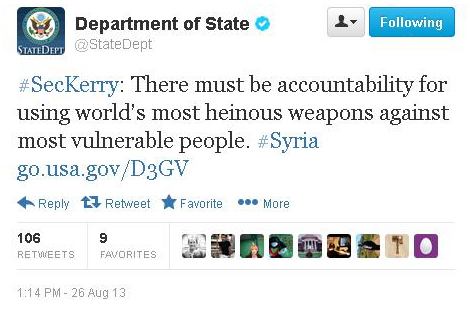
Moral Obscenities

U.S. Secretary of State John Kerry made a statement earlier today about the apparent chemical weapons attack that took place last week in Syria. I agree with him 100% that an attack with chemical weapons against innocent men, women and children is a "moral obscenity." In fact, I would go much further than Mr. Kerry to say that any attack (regardless of the weapon used) against innocent men, women and children is a moral obscenity.

However, in calling chemical weapons "the world's most heinous weapons," I must unfortunately disagree.


There is no doubt that chemical weapons are heinous, should not exist and must never be used again. There is no doubt that - whatever weapons were used on August 21 in Ghouta - the attack was cowardly, shocking and horribly killed hundreds or even thousands of people. But chemical weapons are not the world's most heinous weapons. That dubious distinction belongs to a class of weapons in the arsenal of the United States itself, along with eight other countries around the world: nuclear weapons.

Wednesday, July 31, 2013

Behind the Scenes of the Russian Nuclear Policy

Discussing the role of nuclear weapons in global politics and maintaining Russia’s security at the International Summer School on Global Security in the beginning of July in Abramtsevo, Russia, Eugene Miasnikov, Director of the Center for Arms Control, Energy and Environmental Studies, presented the analysis of the trends in the development of strategic forces of Russia, which can help understand why Russian senior officials reacted so coldly to the US President Obama’s suggestion of further reductions in the nuclear arsenals.   

Miasnikov notes that the Russian view of the role of nuclear weapons is essentially conservative. Though some believe that nuclear weapons have lost their significance and that nuclear deterrence is not more than just a myth, in practice these ideas do not really affect the state nuclear policy. Miasnikov points out, that unlike the USA, the discussion of the role of nuclear weapons among the Russian expert community oftentimes takes place behind the scene, and it is difficult to say in what way it affects the official policy of the Russian Federation.   

In general there is a consensus among Russian experts, Miasnikov says, that the nuclear weapon is (i) the key element of strategic deterrence system; (ii) a guarantor of the Russian national security from an extensive aggression of another state or a group of states; (iii) a guarantor of sovereignty; (iv) an agency that ensures Russia’s high status among other states; in the nuclear area, equal to the one of the USA.

The views of Russian experts differ mainly in regard to the way Russia should respond to the US suggestions for further bilateral cutting of nuclear arsenals.  The views differ, Miasnikov explains, because specialists differentially assess threats and dangers for the Russian Federation as well as prospects of the Russian economy.

Thursday, July 25, 2013

Libyan Disarmament: A Model for Current Nuclear Weapon States?

Libya, a country struggling to maintain stability and order in its post-revolutionary phase, is renowned in the international community for its disarmament efforts in 2003 and its ratification of the Nuclear Non-Proliferation Treaty (NPT).

In March of 2003, former President Muammar Qaddafi renounced Libya’s weapons of mass destruction programs and allowed IAEA inspectors into the country to verify that Libya was in fact making significant steps towards nuclear disarmament.

Libya, along with South Africa, Kazakhstan, Belarus, and Ukraine are among the few states that formerly had nuclear weapons stockpiles but disarmed and became non-nuclear weapon parties to the NPT.

Wednesday, July 17, 2013

The CTBT and the US


This week, the CTBTO is holding a weeklong conference on the CTBTO and the progress being made to ratify the CTBT.  Simultaneously, there is an education program being held both in Geneva and online.  I am one of the participants, and already I have learned so much about the CTBTO and the delegation processes. Part of the course is a simulation of the Executive Council Deliberations over an On-site Inspection Request.  I was selected to be a part of the representative team for Columbia. 

The CTBT is the Comprehensive Nuclear Test Ban Treaty. It was adopted by the United Nations General Assembly on September 10, 1996, but it has not entered into force because eight Annex-2 states have not ratified the treaty.  They are the United States, India, Pakistan, Egypt, Israel, North Korea, China, and Iran.

Once the CTBT is ratified and becomes part of international law, the UN will be able to monitor the world.  If a state violates the CTBT the executive council has been set up for a democratic process to order on site inspections. 

It is the interest of the United States to ratify the CTBT because the United States has already ceased nuclear testing.  The US now uses computers to run calculations and virtual tests that are just as effective as actual tests.  If the US took a leading role in getting the rest of the other states to ratify the treaty, the risk of other states gaining nuclear weapons would be eliminated almost entirely.  The United States also has even more reason to ratify the CTBT since Russia has already done so.  Russia has the second most nuclear weapons in the world.  Russia tested the largest nuclear weapon ever detonated called the Tsar Bomba in 1961. 


This is the most supported nuclear treaty in the world.  The US and others continue to obstruct it.  The US needs to begin working with the international community instead of opposing it.  For the rest of the week, I will be learning more about how the CTBT is practically carried out.  I will also be taking part in the Executive Council simulation.  I hope to learn a lot this week.  Around a hundred other participants from around the world will be joining me.  Perhaps through education and awareness, support can spread for this important treaty.

Thursday, July 11, 2013

Nuclear Weapons in the Cyber Era

For the last 50 years, an outside force has never threatened the United States’ nuclear weapons safety.  The United States has always employed large security forces, secure/remote facilities, and strict protocols.  However, in recent years, and especially recent months, the U.S. and its allies have come under increased cyber attack.  For example, in the summer of 2012, alleged Iranian hackers destroyed 30,000 computers of the Saudi Aramco Company.  Chinese hackers have stolen information on important defense projects from defense contractors.  The designs include the PAC-3, THAAD, and the Navy’s Aegis ballistic-missile defense system.  Also schematics on the F/A-18 fighter jet, the V-22 Osprey, the UH-60 Black Hawk helicopter and the Navy’s new Littoral Combat Ship were stolen.  If these systems were compromised, how long until the U.S. nuclear weapons complex is compromised?  Perhaps it already has been. 

Many analysts are worried about the American banking system or the power grids.  However, I can’t think of a worse situation than if our nuclear weapons were hacked.  A nuclear power plant’s controls could be compromised and next thing we know the US has its own Chernobyl.  The US infected the Iranian nuclear industry with a virus called Stuxnet that severely hindered their progress in 2010.  Is the US immune to this type of attack?  In this age of Internet attacks, any country or group can theoretically attack the United States from a laptop.  These recent escalations in Internet attacks should signal world governments that the need for nuclear disarmament is even more imperative.  If a terrorist organization can’t build their own device, then they can just use one that already exists by hacking the controls or falsifying reports of an attack.  Studies done have shown that the US nuclear arsenal is indeed vulnerable to a cyber attack.


Technology advances at an incredible rate in this age.  Defense systems cannot keep up with the evolving capabilities of offensive tools.  Simply making the US arsenal no longer fire ready would prevent hackers from firing one of our nuclear warheads.  The Cold War is over.  Shifting the US’s nuclear arsenal to be able to address the threats of this age is imperative.  We do not need to be ready for an impending attack from the USSR.  Those days are gone.  We must now be wary that our security systems are all vulnerable.  We must protect ourselves from our own systems as much as from foreign attackers.  Now it seems nuclear weapons and power plants are liabilities.  Deterrence will not work in the Internet age.

Brooks Troiani is an intern at the Nuclear Age Peace Foundation.


Tuesday, July 9, 2013

Science and Religion Reconciliation Center is opening on the basis of Russian Federal Nuclear Center – Seriously?

‘Wait a minute. That can’t be serious, can it?’ immediately popped up in my head when I was reading the following news: 

As the Moscow Patriarchate website reports, on 29 June 2013 the orthodox clergy, representatives of the Department of Economic Development, Department of Agriculture, the administration of the city Sarov, as well as RFNC representatives discussed the opening of a Science and Religion Reconciliation Center (Russian: научно-духовный центр) which will be based on Russian Federal Nuclear Center and the Monastery of the Holy Dormition of Sarov hermitage. The Center, which has received the blessing of Patriarch of Moscow and all Rus' Kirill, will host conferences and other events aimed to build up the dialogue between representatives of science and the Church.

The question arises how are they going to find common grounds to achieve understanding and build friendly relations? Can the views of Nuclear Center,* which developed the first Soviet atomic and H-bombs, and the Church be compatible with one another? What can the Institute that has developed weapons of mass destruction and is working towards their higher performance possibly have anything to do with the Church that is supposed to advocate common values and teach people to appreciate and protect life and the world bestowed on us by God?

For me the idea of a Science and Religion Reconciliation Center is as oxymoronic as the world peace keeping function of nuclear weapons. Let us think about it. If the Church was intending to appeal to the conscious of nuclear scientists, it would probably support organizations fighting for the abolition of nuclear weapons rather than initiate discussions how to reconcile religion and science. As for the funding, why is federal money being spent on the opening of the Center instead of helping out anti-nuclear campaigns?

Maybe I am too skeptical and the Church will indeed help to promote the idea that science should work for the good of humanity and not jeopardize it with such deadly inventions as nuclear weapons. Maybe it will. But the Moscow Patriarchate is ambiguous about the direction in which the further talks will be going. Will the Church try to persuade the Nuclear Center specialists that their work is unethical, immoral, and antihuman? Or will the nuclear experts be able to prove their view to the Church that nuclear weapons serve the only ‘honorable’ purpose of maintaining peace and security for the Russian people and the whole world thus getting the approval of the Church? It is difficult to say based on what information about the new Center’s work is available. We will find out in November when the first conference is scheduled to take place at the Center.

*Russian Federal Nuclear Center - The All-Russian Research Institute of Experimental Physics (RFNC - VNIIEF) - is a Federal State Unitary Enterprise (FSUE) of the State Atomic Energy Corporation “Rosatom”. The Institute was founded in 1946 to implement the Soviet Atomic Project. Now the Institute is intensively working towards higher nuclear weapons performance, improving their efficiency, safety and reliability.
More information about the Institute and its work can be found at http://www.vniief.ru/wps/wcm/connect/vniief/siteeng/nuclearcentre/


Ekaterina Kuzmina is a graduate student at California State University, Fullerton  and an intern at NAPF. 

Wednesday, July 3, 2013

Why Current Deterrence Theory is Wrong

The main argument given against the idea of nuclear abolition is that the “genie is out of the bottle,” and the only thing that keeps more countries from getting nuclear weapons is threatening them with nuclear weapons.  However, Iran and North Korea stand as stark evidence that this is simply not true.  Nation-states will develop nuclear weapons in response to being threatened by nuclear weapons.  In an age where the nuclear armed states can invade any non-nuclear country without drastic consequences, threatened states see that in this mindset, it only makes sense to arm oneself.  The US was able to invade Vietnam, Iraq, and Afghanistan.  I would argue the only reason why the US hasn’t invaded Iran is because Russia and China have threatened retaliation.  Russia invaded Afghanistan in the 80s.  China took over Tibet.  The message the nuclear powers have been sending the rest of the world over the last 50 years is that if you do something we don’t like, and you don’t have a nuclear arsenal, then we can invade you.  Therefore, the logical conclusion is that in reality deterrence leads to proliferation because it creates a mindset in which nuclear weapons are the source of power and therefore necessary.  This is disastrous in an age where terrorists are no longer bound by national barriers.  It is dangerous in a world that is currently fraught with instability and popular unrest.  

Currently, President Obama and President Putin have agreed to lower their arsenals by a third more.  While this looks like a step in the right direction, it is not really progress.  Let me tell you why.  Both Russia and the US are modernizing their nuclear arsenals.  They are spending billions of dollars on making the nuclear weapons more deadly (as if blowing up an entire city-sized area isn’t deadly enough), more difficult to shoot down with missiles, and faster (missiles that can hit a target in 4 minutes rather than ten).  So really while they lower the number of overall warheads, all they are really doing is retiring the old warheads and actually creating a new stockpile of deadlier ones.  I must ask why the US needs to spend billions of dollars on making the deadliest weapons in human history deadlier.  It is almost laughable.  I mean how accurate does a nuclear missile need to be?  If you get within a mile of your target you will still vaporize it.

For example, the old WWII nuclear bombs dropped on Hiroshima and Nagasaki are 80 times weaker than our smallest nuclear warhead now.  Our smallest nuclear warhead completely annihilates a 1.7 mile radius around the detonation spot.  Most buildings and all living things in this area are wiped out instantly.  They get off lucky.  Then within a 2.7 mile radius from the blast (or 1 mile outside of the instant death area) all buildings except for steel structure are gone, fifty percent of living things are instantly killed, the other  fifty percent is mortally burned or wounded and will die within the coming minutes, hours, or days after the blast.  At a 4.7 mile radius from the blast center (or 2 miles outside of the last damage radius), all houses are destroyed by the blast wave, an estimated five percent of the population is instantly killed, forty-five percent are injured, all have been exposed to toxic levels of radiation.  They will most likely die slowly and painfully of radiation poisoning.  At a 7.4 mile radius (or roughly 3 miles from the last damage radius) there is still blast damage but only twenty-five percent of the population is injured.  After this point there is less damage from the blast itself, however every living thing within thirty miles from the blast center has been exposed to lethal doses of radiation.  They will die within days, and that area will be uninhabitable for ten years.  Within ninety miles, all living persons will die of radiation poisoning, also within days.  Within 160 miles, people will show symptoms of radiation poisoning: hair loss, white blood loss, nerve damage.  The elderly, the young, and the sick will die.  Finally within 250 miles from the blast center, radiation poisoning will occur, though most will live.  Also, the land will be safe to inhabit within three years.  This is the effect of both the US and Russia’s smallest nuclear warhead.  In another report, this time on a terrorist nuclear attack on New York City estimates that there would be 800,000 people killed, and 900,000 people injured.  Those are the effects of the smallest warheads.  If anything bigger is used the results are dramatically worse.  The fact remains if ever a nuclear attack were to occur on any city the results would be horrifying.  While deterrence may have prevented a nuclear attack from another country, no amount of nuclear weapons can prevent a terrorist from acquiring a nuclear weapon. 

How do you prevent a terrorist from getting a nuclear warhead?  Well one way is to keep nuclear weapons in secure facilities.  However, countries like Pakistan and India have questionable security, and the US can’t regulate their security.  Also, in Pakistan’s case, if government rule was to break down, nothing would stop terrorist groups from gaining access to those weapons.  However, if the nuclear powers come to an agreement to set a date for virtual disarmament, boost the power of the IAEA to regularly inspect and regulate nuclear programs in all countries, and agree to support the enforcement of the agreement through UN military force and sanctions then the disarmament could be permanent. This is quite a lot to ask from most of the nuclear powers.  However, I believe that security from nuclear attack should trump sovereignty in this instance.  If there is no enforcement, then there is no punishment for failing to make good on disarmament.  Once countries disarm, it would be very easy to make sure no country starts arming again because creating weapon’s grade plutonium is a lengthy, expensive, and fairly obvious endeavor.  Think about it; no terrorist organization has been able to make one because doing so requires building huge facilities and employing experts who are under surveillance.  Even North Korea, the most secretive country in the world, didn’t keep their nuclear weapons development a secret.  As long as the IAEA and various intelligence agencies do their jobs, no country could get away with making a nuclear weapon. 

So why is it likely that this idea won’t come to fruition?  First of all, the belief in nuclear deterrence is accepted as fact by both parties in Washington and Moscow.  Second, there is still little trust for the Russians in Washington DC.  The good news is that Russia is not our enemy anymore, and this mentality could be changed through effort.  For some reason, many politicians in America and Europe still see Russia as a country to fear instead of work with.  The truth is the moment America takes off its Cold War goggles and views Russia in a new way is the moment in which nuclear disarmament talks will actually bear fruit.  If the two countries with the largest nuclear arsenals and worst nuclear track records start transparently and honestly disarming, is when the rest of the world will see that a commitment to a nuclear-free world is actually possible.  Current deterrence ideology has failed.  However, I believe that if the world is transparently disarmed and then honestly regulated, nuclear weapons development can be deterred.

Sources:
Nuclear affects estimations come from: http://www.nationalterroralert.com/nuclear/

New York City scenario: http://www.atomicarchive.com/Example/Example1.shtml

Brooks Troiani is an intern at the Nuclear Age Peace Foundation.

Tuesday, July 2, 2013

We Must Rely on Common Human Values not Nuclear Arsenals as Our Strength, or the Need for a Bold Initiative at the State Level

In the light of the recent events regarding the currently most discussed whistleblower Edward Snowden, it is impossible not think about the importance of having a moral compass that guides you and motivates you for bold actions.  Having realized that he was "part of something that was doing far more harm than good," Edward Snowden decided to disclose NSA unethical activities. Driven by the desire to serve his people and humanity Snowden urges, 'You can't wait around for someone else to act.' Snowden’s courage and his willingness to sacrifice his comfortable life and take a bold risk to change the system that works against humanity rather than for it deserves admiration. And it is this what global leaders lack in regards to nuclear weapon discourse.

If world leaders really care about the global community, the common good, the future generations, why have they failed to avoid emergence of new nuclear states and to prevent states from obtaining, possessing, and developing nuclear weapons (not to mention to achieve the elimination of nuclear weapons altogether)? The answer is unfortunately that we are stuck at the stage when we do not  trust each other. We do not believe that we are able to reach an agreement on important issues through negotiations, and we still need something frightening (like military arsenal) to back up our position and our intentions.

On June 19 in Berlin, American President Barack Obama reminded us of the words of John F. Kennedy asking to “look to the day of peace with justice, beyond yourselves and ourselves to all mankind.” These words “call upon us to care more about things than just our own self-comfort, about our own city, about our own country.  They demand that we embrace the common endeavor of all humanity.”

Obama urged to pursue the security of a world without nuclear weapons because “we may no longer live in fear of global annihilation, but so long as nuclear weapons exist, we are not truly safe.”  He also mentioned that American and Russian deployed nuclear warheads had been cut to their lowest levels since the 1950s but pretermitted that new, more precise, and more sophisticated nuclear weapons are being developed. We have heard enough loud words about good intentions of our leaders to abolish nuclear weapons. What we need to solve this problem is that somebody decides to make the first step and set an example. Success is gained by resolving on acting not speaking. During the Cold War the United States and the Soviet Union/Russia demonstrated the whole world that the power rests on nuclear arsenal, and as long they procrastinate and put off total nuclear disarmament they continue sending this message and more states will want to become nuclear. The USA and Russia opened the Nuclear Age and it is their responsibility to put it to an end.

Unfortunately, neither the US nor Russia is willing to take a risk and just do it. “We cannot afford to disrupt the balance of the system of strategic deterrence,” Russian President Vladimir Putin replied to Obama’s suggestion to cut US and Russian nuclear arsenals by one third. We still think in terms of deterrence. We are still afraid that if one of us has military predominance, it would use it to its advantage and try to take control over the other. And probably Russian authorities have good grounds for such apprehensions taking into account decisions made by the US unilaterally in the past that affected the global community.  We do not trust each other. And we are to blame because we never gave each other a reason to do so.

We still live in the world (created by ourselves) where nuclear weapons equal power. Nuclear weapons guarantee that your voice will be heard and your opinion will be counted. It reveals the injustice, inequality, and weaknesses of the global community. It reveals that some states do not have the same say in global decision making and their opinion is valued less than those of “mighty” states. It reveals that we distrust each other, fearing that those who have military might can dictate their will and impose their rules. It reveals our ignorance, our inability to negotiate and understand each other, our incapability to build amicable, open, trustful relations with each other. We are obsessed with power. That is human nature. But we are not greedy, arrogant, ignorant, and bloodthirsty creatures. We are human beings and we must remind ourselves what it means to be human. It means showing such qualities as kindness, sensitivity, and compassion, among others. I repeatedly use ‘we’ implying people, appealing to everybody, to all people on earth because we are all the same.

For centuries we have been dehumanizing and even demonizing each other, focusing on what differentiates us from one another such as color of the skin, language, culture, religion, way of life, and beliefs rather than what unites us. We have been creating monsters of each other, justifying inequality, injustice, and wars, rather than trying to find common grounds for peaceful coexistence on the planet that has resources sufficient for everyone to have a decent and comfortable life.  Those of us who have power have been trying to impose their way of life, their ideals on others, to reduce difference to make it comfortable for them, to make it more understandable, to make it safer. We are afraid of differences. We are scared of those who differ from us and we try to make them more like us instead of trying to understand them. If we put aside all external attributes that frighten us off, we will be able to see that we are not that different after all. All people want and pursue the same things: peace and security, a dignified life, and the right to be different.  Let us start here. Let us be different and not be afraid of it, but appreciate and celebrate the diversity and beauty of life.

Barack Obama’s suggestion to reduce and eventually eliminate nuclear weapons was met with skepticism not only by Russian politicians concerned about the shift in strategic balance it may cause, but also by American officials like Senator Sessions who said that it is a dangerous policy and it is “driven by an ideological vision of the president, of the world without nuclear weapons,” stressing that the security of America and its allies depends on strong deterrence that includes maintaining a nuclear arsenal.  In other words, the Senator believes that it is impossible to have a secure world without nuclear weapons. Maybe he is right. Maybe it is an ideological vision and even an idealistic one especially for those who were born in the Nuclear Age and who do not know what it is like to live without fear of nuclear holocaust. But everything begins with an idea and faith. Even the invention of an A-bomb started with an idea that occurred to a curious mind.  The world free of this “miraculous inventiveness” is a dream of billions, a dream that we hope will come true. We actively use our minds to solve problems, create new inventions, and build an environment in which we feel safe and comfortable. We hope that we will also apply our hearts to what we do. We hope that we will stop relying on technologies and begin to trust each other. We hope that we will stop working on technological progress and start working diligently on human relations.  We must stop drifting along in the direction heading nowhere but extinction of all life. We need to be bold like Edward Snowden to resist the system that works against our humanity and we need bold leaders to change the course of history.

It would be reasonable to expect a bold initiative from the US government. For the United States exercises its power globally on an unprecedented level. For decades the United States assumes the role of “leader of the free world” to spread and protect democratic values, ideals, and freedoms. However, the past has revealed the hypocrisy of the US benevolent leadership: the undemocratic character of methods used to establish the rule of law and liberal order in the world. America’s intervention in other nations’ affairs is often seen as an attempt to enforce its order and build societies that are compatible with its vision of the world rather than “assist people to work out their own way” as Truman declared in his famous 1947 doctrine.  America has shown that it can be aggressive and even violent. It has also demonstrated its inclination to control and set its rules. Such policies and strategies make other states to want to possess nuclear weapons to deter the United States from undue intrusion in their affairs, to protect their way of life, to defend their right to be different. At the same time the continuous reliance of the United States on its nuclear arsenal sends the message that its power and leadership are based on its military might, not common human values and democratic principles it claims to be a faithful advocate of.      

We urge the US leader to have the courage to finally take “a bold initiative consistent with America’s moral heritage,” requested by Kissinger, Nunn, Shultz and Perry in 2007. We encourage him to abolish the US nuclear arsenal and thus set an example worthy to admire and follow. We ask him to be strong enough not to be afraid of becoming weak. We ask him to trust his allies who would back up America if required. We encourage him and the rest of the world to see the power in the values shared by all people and not in the weapons. We urge the US President and other global leaders to stop promising and act.    


Ekaterina Kuzmina is a graduate student at California State University, Fullerton  and an intern at NAPF. 

Wednesday, June 19, 2013

President Obama in Berlin: "So long as nuclear weapons exist, we are not truly safe.”

President Barack Obama at Berlin's Brandenburg Gate
Today, in front of the historic Brandenburg Gate, US President Barack Obama stood where Ronald Reagan and John F. Kennedy before him also stood.  He uttered the words now made famous “Ich bin ein Berliner” to a cheering crowd waving German and American flags together.  President Obama addressed the issue of nuclear weapons and proliferation in his speech.  Perhaps more importantly, Obama said, “We may no longer live in fear of global annihilation, but so long as nuclear weapons exist, we are not truly safe.”  While most likely rhetoric, Mr. Obama was correct when he said this; for as long as weapons exist that can take out entire cities and regions, no country or people are safe if war breaks out. 

President Obama championed the New START Treaty in his speech saying, “I intend to seek negotiated cuts with Russia to move beyond Cold War nuclear postures.”  However, unless Mr. Obama has had some great change of heart, his actions during his Presidency regarding nuclear weapons have yet to meet the expectations laid out in his grandiose speeches.  The New START Treaty is made to sound ambitious and groundbreaking, it is however very conservative in its changes and unimaginative.  The new treaty sets the deployed weapon limit at 1550 warheads for each country.  The estimate of the US stockpile is estimated at 4,650 warheads, of which around 2,150 are deployed.  Russian nuclear stockpile is estimated at 4,500 weapons.  Only 1,800 of those warheads are deployed.  So the limit of 1550 really isn’t that drastic of a change.

Thursday, November 8, 2012

Leave Him Alone?

Yesterday, I sent out an action alert asking our members to write to President Obama and ask him to cancel next week’s test of a Minuteman III Intercontinental Ballistic Missile. Thousands of people immediately took action, asking him not only to cancel next week’s test, but also to work quickly in his second term to decommission land-based ICBMs.

As always, I am deeply grateful to our thousands of dedicated members who take action to support the elimination of nuclear weapons. This wide support from around the United States gives us the public voice we need to be able to get our foot in the door in Washington, DC.

I got a couple of replies from people to the effect of, “Come on, give the guy [Obama] a break. He just won re-election. Let’s savor this victory for a while.”

Here’s why I disagree with that assessment:
  • The Air Force isn’t planning to give us, or the Marshall Islanders (the target of the November 14 test), a break by postponing the test. 
  • Conducting this test would be a terrible message to send to the world immediately after the President’s re-election. We’re talking about a missile that carries thermonuclear warheads at least eight times more powerful than the bomb that destroyed Hiroshima.
  • We are trying to hold President Obama to his 2008 campaign promise to “renew the goal of a world without nuclear weapons.”

To read more about why the Nuclear Age Peace Foundation believes that the United States should decommission its land-based Minuteman III missiles, see this article in the Christian Science Monitor by NAPF President David Krieger and Pentagon Papers whistleblower Daniel Ellsberg.

Wednesday, September 12, 2012

What Does Your Political Party Say About Nuclear Weapons?

The 2012 U.S. Presidential election season is well underway, and among the most important political issues that America faces is determining a policy on nuclear weapons. The following passages are the official stances on nuclear weapons from the Democratic, Republican, and Green Party platform. Each party platform addresses the issue of nuclear weapons proliferation and disarmament, in regards to both the U.S.'s nuclear program and nuclear programs abroad.

Tuesday, September 4, 2012

My Letter in the Wall Street Journal

The Wall Street Journal published a letter to the editor from me on Sunday, September 2. It appears as if the Journal is no longer archiving letters to the editor online, so the full text of the letter appears below.

The letters to the editor page is the second-most widely read page of a newspaper after the front page. It is a great way to get your message across to readers, especially in a publication known for coming down on the other side of your issue of interest.

I encourage everyone to write letters to the editor on issues they care about - both local papers and national ones. You can read my suggested guidelines for writing a letter to the editor here.

Here's the text of my letter, which refers to an op-ed that had been published by the Wall Street Journal earlier that week:

Mr. Kozak certainly places a lot of faith in the idea that "rational actors" with their finger on the nuclear trigger will act rationally at all times, even under extreme stress during times of war. This dangerous assumption overlooks the fact that one irrational decision with nuclear weapons could set off a chain of events that could kill hundreds of millions of people around the world through nuclear famine.
Furthering the gap between nuclear "haves" and "have-nots" through military action, as Mr. Kozak not so subtly infers, will only increase the incentive for other countries to develop nuclear weapons quickly. Negotiations for a Middle East Weapons of Mass Destruction-Free Zone, which would include both Iran and Israel, are supposed to take place in the coming months. This is a sensible way to halt real and possible nuclear proliferation in this volatile region of the world.
Rick Wayman
Nuclear Age Peace Foundation
Santa Barbara, Calif.

Tuesday, August 28, 2012

Iran Call for Nuclear Abolition by 2025 is Unreported by New York Times

Logo of the Non-Aligned Movement
(photo: Wikipedia)
This guest blog was written by Alice Slater.

The Non-Aligned Movement (NAM), formed in 1961 during the Cold War, is a group of 120 states and 17 observer states not formally aligned with or against any major power bloc.  The NAM held its opening 2012 session yesterday under the new chairmanship of Iran, which succeeded Egypt as the Chair.

Significantly, an Associated Press story in the Washington Post headlined, “Iran opens nonaligned summit with calls for nuclear arms ban”, reported that “Iranian Foreign Minister Ali Akbar Salehi opened the gathering by noting commitment to a previous goal from the nonaligned group, known as NAM, to remove the world’s nuclear arsenals within 13 years. ‘We believe that the timetable for ultimate removal of nuclear weapons by 2025, which was proposed by NAM, will only be realized if we follow it up decisively,’ he told delegates.”

Friday, August 10, 2012

Prisoner's Dilemma Applied to International Treaty Interpretation


            Two prisoners are brought into a precinct.  Separately, the individuals are approached by an attorney to negotiate a ‘deal’ for prison length.  These prisoners are presented with options: defect or cooperate.  In defecting, prisoner A rats out prisoner B.  In cooperating, prisoner A does not rat out prisoner B, in assumption (or hope) that prisoner B will also cooperate.  Prisoner B is given mirrored options.  The payoffs depend on the option the prisoners choose.  If prisoner A betrays B while B cooperates, prisoner A comes out on top; if both prisoners cooperate, they both win- a mutual benefit; when both rat out each other, both lose; and, when prisoner A cooperates, but B betrays, prisoner A loses.  If this sounds familiar, it is because it is a popularized international relations (IR) theory coined as the Prisoner’s Dilemma, and stems from rational choice-Game Theory in political science academia.  In recent, however, this dilemma has found scholarship in explaining international law of treaties. 
            Because there is no domineering international legislature or centralized lawmakers, it remains very difficult to implement international law.  Thus, treaties become monumental in maintaining international harmony and cooperation.  They can be thought of as an international public service/good. 
            As mentioned, treaties are designed to encourage international relations among nations.  Therefore, when nations became signatory to a treaty (and upon ratification of a treaty), they make a public commitment to abide by its rules/articles. 

Tuesday, August 7, 2012

Call for Peace from Hiroshima and Nagasaki


Nagasaki Peace Bell

At 8:15 am, on August 6, the Peace Bell at the Hiroshima Peace Park begins ringing, and people closing their eyes start praying for the victims of atomic bombings as well as for world peace without nuclear weapons. Another bell rings in Nagasaki at 11:02 am on August 9.


Last summer, I visited Nagasaki and attended the peace ceremony for the first time. Despite hot and humid weather of summer in Nagasaki, many people came to the Peace Memorial Park, including hibakusha (A-bomb survivors), politicians, students, children, and people from other countries. I was outside of the main place when I heard the peace bell ringing. With complete silence in the park, the deep sounds of the bell were only resonating as if it was carrying all the memories of the A-bomb victims and our prayers for world peace.  


Monday, August 6, 2012

The Unnecessary Bombing of Hiroshima: 67 Years Later

Today marks the 67th anniversary of the bombing of Hiroshima. August 6th, 1945 is day in which violence, hate, and patriarchic posturing led to the unnecessary death of hundreds of thousands of people. While the actions of the American government are often described as regrettable, unfortunate, and horrific, we also celebrate these bombings either through claiming their necessity or in the indoctrination of false history for our children within their schools.

Are bombs really an answer to our problems? This blog will describe two scenarios, one fictional and one historical, which prove nuclear weapons are not a solution to international conflict.

Nuclear Weapons Were Not Needed in Japan

Growing up in school I was always taught the Japanese war effort was still strong going into the summer of 1945; that a full land invasion of Tokyo would be required for the allies to cause Japan to submit. It is this logic that is used to justify the intolerable use of nuclear weapons on the civilians of Japan. This could not be further from the truth. Admiral William D. Leahy, the President's Chief of Staff, wrote in his memoir that, “The use of this barbarous weapon at Hiroshima and Nagasaki was of no material assistance in our war against Japan. The Japanese were already defeated and ready to surrender.”1


Wednesday, August 1, 2012

The Story of Sadako and the Thousand Paper Cranes


The Story of Sadako and the Thousand Paper Cranes


August is a bittersweet month. It is the month in which we mournfully remember the atomic bombings of Hiroshima and Nagasaki on August 6 and August 9 during the final stages of World War II. The nuclear weapons, developed and deployed by the United States, brought complete obliteration to the two cities and killed approximately 200,000 Japanese from both immediate and long-term effects. Most of the Japanese who fell victim to the nuclear weapons were innocent civilians. The laws of war and ethical standards were shattered, and the United States set a precedent of nuclear proliferation. Yet, although August is the month in which we reflect on the horrors of Hiroshima and Nagasaki, it is also the month in which worldwide peace efforts that stemmed from such tragedy are celebrated. The story of Sadako Sasaki is one story that has inspired generations to pursue a peaceful and just world.
Related Posts Plugin for WordPress, Blogger...